Home › Blog › How to Practice Carrom Alone: A Solo Training Guide
How to Practice Carrom Alone: A Solo Training Guide
Last updated: October 15, 2026
A practical guide to building real carrom skill alone through focused solo drills, a repeatable practice routine, and targeted work on angles, thumb shots, and the queen.
Published
Quick answer
You can practice carrom alone by drilling one shot at a time — straight pocketing, angles, rail rebounds, thumb shots, and queen covers — using a tidy board and a repeatable routine instead of a partner.
Key takeaways
- Drill one shot type at a time instead of shooting randomly.
- Reset coins after every attempt instead of chasing lucky angles.
- Thumb shots and queen covers need slow, low-power reps before adding power.
- A clean, fast board matters for solo practice just as much as in a real match.
- An AI opponent or trick shot puzzles can fill the gap a practice partner leaves.
You can practice carrom alone just as well as you can with a partner — set up the board, pick one drill, and work the same shot until it's automatic before you move to the next.
What can you actually practice carrom alone?
Almost everything that matters in a real game is something you can work through solo: straight pocketing, angled shots, rail rebounds, thumb shots, and the full queen cover sequence. The only thing missing is an opponent reacting to your position, so you have to supply the discipline yourself. A few solo carrom drills, done properly and in order, teach your hand more in twenty minutes than an hour of random shooting ever will.
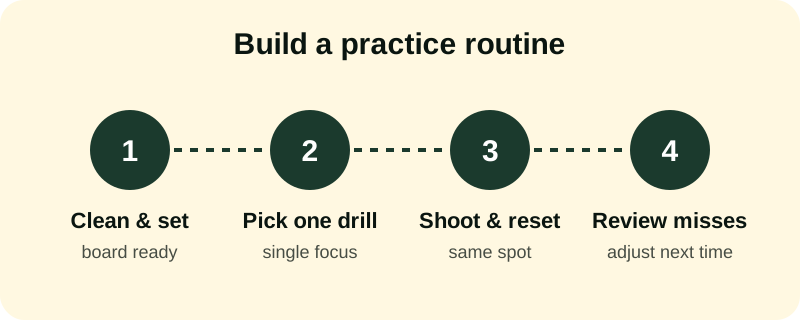
The structure matters more than the number of shots you take. A loose session where you just flick coins around teaches your hand very little; a session built around one skill at a time teaches you something every single rep.
- Wipe the board and dust it the way you would before a real match.
- Arrange coins for one specific drill instead of a full game layout.
- Shoot the same shot five or six times from the same spot before moving on.
- Reset the coins after every attempt — don't just keep shooting from wherever they land.
- Note which misses repeat, and spend your next session only on that shot.
What are the best solo carrom drills to run?
Start with the shots you'll actually use in a real game, not the flashy ones. Practicing carrom without a partner works best when every drill isolates one specific skill instead of trying to simulate a whole match.
- Straight pocketing — place one coin on a short, direct line from a pocket and shoot it in from the same striker position until you can call the result before you flick.
- Angle shots — move the coin off the straight line and work out where the striker needs to make contact; this is the skill that separates controlled play from lucky play.
- Rail rebounds — bank the striker off the side into a coin near a pocket; it looks harder than it is once you've drilled the angle enough times to trust it.
- Baseline variety — shoot from every position along your base line, not just the middle, since real games rarely hand you the easy spot.
| Drill | What it builds |
|---|---|
| Straight pocketing | Consistent striker contact |
| Angle shots | Reading the geometry of a shot |
| Rail rebounds | Trusting a bank shot under pressure |
| Queen cover sequence | Timing a two-shot combination |
| Thumb shots | Comfort shooting backward |
If you want a sharper sense of where the striker should actually contact the coin, a guide to aiming accurately in carrom is worth running through before you start a session — it gives you something concrete to check your angle against instead of guessing.
How do you practice the queen and thumb shot without a partner?
The queen cover is a timing problem more than a power problem, which makes it a genuinely good solo drill. Place the queen in its starting position, pocket one of your own coins near a pocket first, then practice the follow-up queen shot you'd actually attempt in a real game. A full breakdown of what it takes to actually cover the queen is worth reading if you keep losing it back to the board.
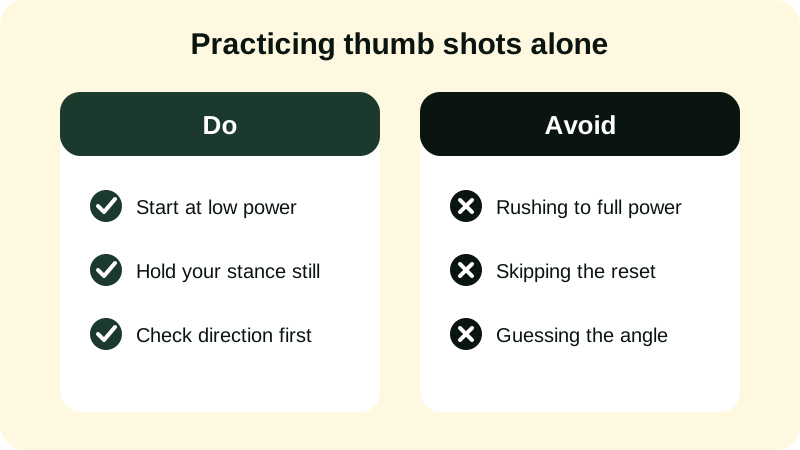
Thumb shots are harder to self-correct because the whole point is shooting backward toward your own baseline, which feels unnatural until it isn't. Set up a single coin behind the striker's starting line and work the motion slowly before adding power — a step-by-step thumb shot guide breaks the grip and release down if the motion still feels foreign.
Does the board itself affect how well solo practice works?
A sluggish board quietly ruins a carrom practice routine, because a shot that drags will make a correct angle look wrong and an incorrect one look fine. Keep the surface clean and gliding evenly before you judge whether a drill is working — otherwise you'll end up correcting your technique for a problem that was actually the board's. A board maintenance guide and a rundown of powder alternatives at home are both worth a look if your sessions feel inconsistent from one day to the next.
Can an AI opponent or trick shot puzzles replace a real practice partner?
A real opponent forces you to adapt in ways solo drilling can't fully replicate, but a reasonably smart AI gets you most of the way there, since it still reads the board and punishes a careless shot. Carrom, a mobile carrom game built around real physics with 5 AI difficulty levels and a set of Trick Shot Puzzles, is designed for exactly this kind of between-sessions practice. It isn't released yet, but you can get notified when it launches if you'd rather test what you've drilled on your phone between real sessions on the board.
Whatever you use to fill the opponent-shaped gap, the actual skill still comes from the board in front of you. More carrom technique and practice guides are on the blog if you want to keep building out a full solo routine.
Frequently asked questions
Do I need a second person to get better at carrom?
No — most carrom skills are things you build alone: straight pocketing, angle shots, rail rebounds, thumb shots, and the queen cover sequence. A partner adds pressure and unpredictability, but a focused solo practice routine builds the actual mechanics faster than casual games often do.
What's the single best solo carrom drill for beginners?
Straight pocketing from the same striker position, repeated until you can predict the result before you flick. It isolates consistent contact without the complication of angles, and it's the foundation every other shot builds on.
How many times should I repeat a shot before moving on?
There's no fixed number — repeat it until the result feels predictable rather than lucky, then add difficulty. If you're still missing the same way after several tries, slow down and check your striker position before trying again.
Can I practice the queen shot without an opponent?
Yes. Set the queen in its usual spot, pocket one of your own coins near a pocket, then practice the follow-up queen shot you'd actually attempt in a real game. It's a timing drill more than anything, which suits solo practice well.
Is practicing against an AI opponent useful?
It helps fill the gap a human partner leaves, since a decent AI still reacts to the board and punishes careless shots. It won't fully replace match pressure, but it's a reasonable way to test what you've drilled solo.