Home › Blog › Carrom Thumb Shot Technique: A Step-by-Step Guide
Carrom Thumb Shot Technique: A Step-by-Step Guide
Last updated: October 8, 2026
A practical guide to gripping, executing, and troubleshooting the carrom thumb shot for extra power and control.
Published
Quick answer
The carrom thumb shot technique flicks the striker with the thumb instead of a finger, giving a flatter, faster line. Use it for breaks, long pots, and pushing through crowded coins, not for soft, delicate taps.
Key takeaways
- A thumb shot trades finesse for extra power and a flatter line.
- The motion comes from the thumb joint, not the whole arm.
- Best used on breaks, long pots, and crowded clusters.
- Gripping the striker too tightly is the most common mistake.
- Practice short, controlled flicks before adding full power.
The carrom thumb shot technique is simply flicking the striker with your thumb instead of your index or middle finger, which gives you more raw power and a flatter, faster line on direct shots. Most players learn the finger flick first and add the thumb shot once they want extra pace on breaks and long pots.
What is a thumb shot in carrom, and when should you use it?
A thumb shot uses the pad of your thumb to snap the striker forward, rather than the sweep of a finger that most beginners learn first. The power comes from a quick, short release of the thumb joint, not from your whole hand moving — that's what gives it a harder, flatter hit than a standard flick.
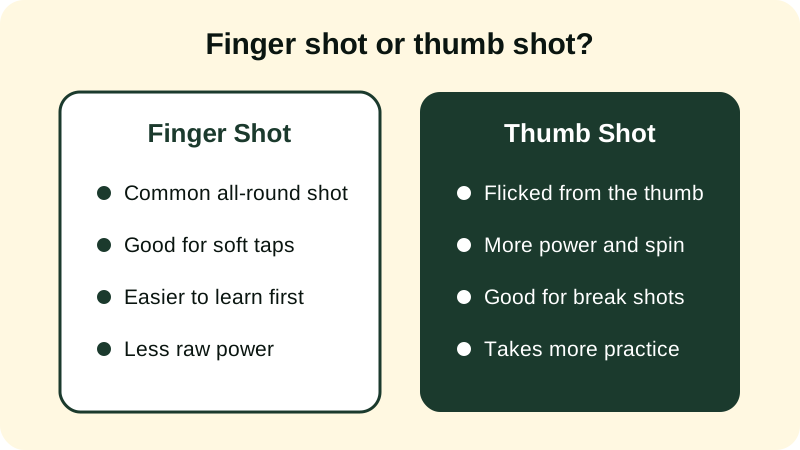
It isn't meant to replace your regular shot — it's a tool for specific moments. Reach for it when you need to break into a tight cluster of coins, send the striker the full length of the board for a long diagonal pot, or punch through a coin that's blocking your path. For anything delicate, like a short tap near a pocket, a normal finger flick still gives you better control. If you haven't nailed the basics yet, it's worth reviewing how to play carrom before layering trick shots on top.
How do you grip and execute a thumb shot step by step?
The grip matters more than the power. Your base hand needs to stay completely still on the board while only your thumb moves — any wobble in the wrist or forearm turns a clean thumb shot into a wild one.
- Rest your hand flat on the board with your fingers spread for a stable base, the same way you would for a finger shot.
- Position your thumb against the striker at the angle you want the shot to travel, with the rest of your hand staying relaxed and still.
- Pull your thumb back slightly against the striker to load the flick, without shifting your base hand at all.
- Release the thumb in one quick, short snap — the motion should come from the thumb joint, not the whole hand or arm.
- Follow through just enough to see the striker leave cleanly, then check where it ended up relative to where you aimed.
Striker weight changes how this feels more than players expect. A lighter striker shoots off faster for the same amount of thumb snap, while a heavier one needs a firmer release to get the same speed — if your thumb shots feel inconsistent, it's worth reading up on carrom striker weight and size to make sure you're playing with something that suits your hand.
Which shots actually benefit from a thumb flick?
Not every position calls for a thumb shot, and using it reflexively is a quick way to lose control of the board. It earns its place in a handful of specific situations where power matters more than touch.
- Opening break: a strong, flat hit into a tightly packed group of coins scatters them for easier follow-up shots.
- Long diagonal pots: the extra pace helps the striker hold its line across the full length of the board instead of losing speed and drifting.
- Clearing a blocker: when an opponent's coin sits between your striker and your target, a thumb shot can drive through it cleanly rather than deflecting off at an odd angle.
- Setting up a cover shot: a well-placed thumb shot can reposition your own coins for an easier follow-up, which matters a lot once you're trying to pocket and cover the queen.
Outside of these moments, stick with your regular finger flick. Power you don't need just adds risk — it's harder to stop the striker precisely once it's moving fast, and a fast miss usually leaves your opponent an easy turn.
What common mistakes ruin a thumb shot?
Almost every bad thumb shot traces back to the same handful of habits, and they're easy to fix once you know what to look for.
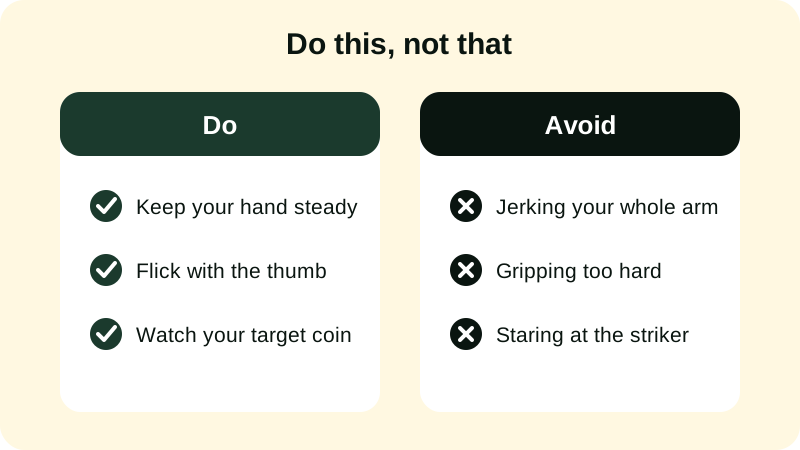
The biggest culprit is moving the whole arm instead of just the thumb — it feels more powerful in the moment, but it destroys your aim because the base hand shifts along with it. A close second is gripping the striker too hard before the flick, which tightens the forearm and makes a smooth release almost impossible. And watching the striker instead of your target coin is a subtle one: your eyes should stay on where you want the coin to go, not on the motion of your own hand.
Board condition matters here too — a sluggish surface makes players compensate with more arm motion, which brings back all the mistakes above. Keeping the board gliding properly with a quick look at a carrom board maintenance guide removes one more variable from your shot. Once the grip, the motion, and the surface are all working with you instead of against you, the thumb shot stops feeling like a trick and starts feeling like just another shot in your rotation. If you want a low-pressure place to drill it, Carrom — the mobile version of the game, built with real physics and not released yet — is worth getting notified about for whenever it launches.
Frequently asked questions
Is the thumb shot harder to learn than the finger shot?
Yes, slightly. Most players learn the finger flick first because it's easier to control at low power. The thumb shot takes more practice to keep accurate since the extra power makes small aiming errors more obvious.
Can you use a thumb shot for delicate taps near a pocket?
You can, but it's not ideal. The thumb shot is built for power and a flat trajectory, so it's harder to feather softly. For short, gentle taps near a pocket, a finger flick usually gives better control.
Does striker weight affect how a thumb shot feels?
Yes. A heavier striker needs more thumb snap to move at the same speed, while a lighter one can shoot off too fast. Getting comfortable with your striker's weight makes the thumb shot far more predictable.
Why does my thumb shot keep going off-line?
Usually it's the wrist or whole arm moving instead of just the thumb joint, or the striker hand shifting position mid-flick. Keep your base hand completely still and isolate the motion to the thumb for a straighter line.