Home › Blog › Tips to Win at Carrom: A Real Strategy Guide
Tips to Win at Carrom: A Real Strategy Guide
Last updated: October 12, 2026
A practical strategy guide covering aim, queen timing, board-reading habits, and doubles play that actually raises your carrom win rate.
Published
Quick answer
The best tips to win at carrom are simple: prioritize accurate aim over power, only pocket the queen when you can cover it, clear easy coins before the board fills up, and think about where your striker lands, not just what it hits.
Key takeaways
- Accurate aim beats raw power in almost every carrom shot.
- Never pocket the queen without a clear cover shot ready.
- Clear your easiest coins early before the board gets crowded.
- Watch where your striker lands, not just what it hits.
- In doubles, agree on coin assignments before every shot.
The best tips to win at carrom all come down to two ideas: control beats power, and the queen is a liability until you can cover it. Get those two habits right and a solid carrom winning strategy builds itself from there.
What's the one skill that wins more carrom games than anything else?
Accurate aim beats a hard flick almost every time. A soft, well-lined shot that pockets one coin cleanly is worth more than a hard strike that scatters three coins and pockets none, because carrom rewards precision and positioning as much as it rewards power. Beginners tend to flick harder when they're frustrated, which almost always makes things worse, not better.
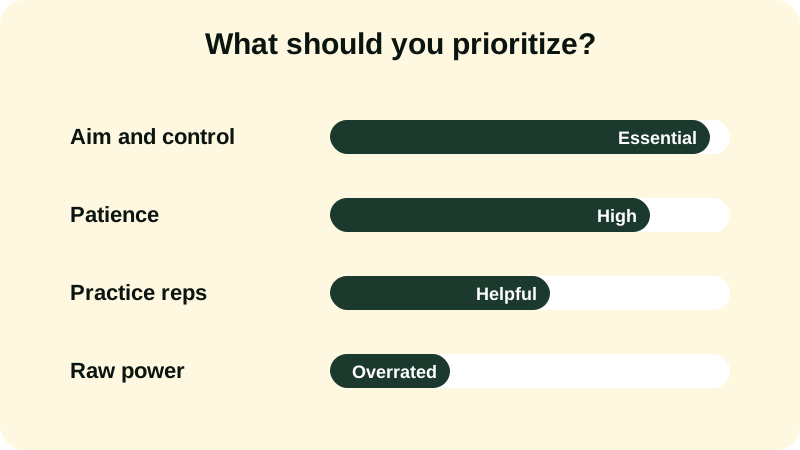
Most players over-flick when they're nervous, which sends the striker off-line and leaves it sitting in the open for your opponent's next turn. Before every shot, spend an extra second checking your sighting line instead of your power — dialing in your aim is the fastest way to actually learn how to win carrom games, faster than learning any trick shot. Lining up a shot properly is worth practicing on its own, away from a full game, until the motion feels automatic and you stop thinking about it mid-shot.
Striker choice plays a role here too. A striker that feels right in your hand — not too light, not dragging across the surface — makes consistent contact far easier to repeat shot after shot. That consistency is what lets you trust your aim under pressure instead of second-guessing it, which is why it's worth reading about what actually matters in a striker before you blame your technique for a rough patch.
How should you play the queen to actually win, not just pocket it?
Pocketing the queen too early is one of the most common ways to lose momentum in a game you were otherwise winning, because most games require you to cover it with one of your own coins right after, and a crowded board makes that much harder than it looks from the sideline.
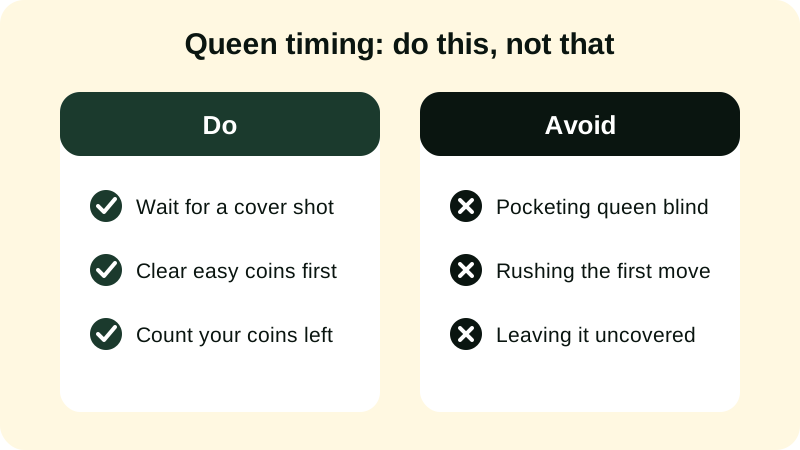
The smarter move is patience: let the board open up a little, and only go for the queen once you can picture a realistic cover shot waiting behind it. If you can't see that cover before you take the queen shot, it's almost always better to clear an easier coin instead and come back to the queen once your side of the board is clearer. Covering the queen correctly is worth understanding in detail on its own, since mishandling it is often the exact difference between a winning streak and handing your opponent a free turn at the worst possible moment.
What strategic habits keep you ahead shot after shot?
Winning consistently is less about any single flashy shot and more about reading the board one move ahead, the same way a decent card player keeps track of what's already been played. Good carrom tactics mean looking at what you're leaving behind for your opponent after a shot, not only at what you're about to pocket.
- Clear your easiest coins first. Open shots disappear fast once the board fills up, so take them while they're available instead of saving them for later.
- Play defensively when nothing's open. A gentle tap that repositions a coin without giving your opponent an easy target beats forcing a risky shot.
- Watch where your striker lands. A striker left sitting near a pocket or an opponent's coin is a gift — plan your follow-through, not just your contact.
- Don't chase every coin near a pocket. A coin close to a pocket at an awkward angle is often a trap; missing there hands over control for nothing.
- Save a defensive shot for emergencies. If your turn is about to produce nothing useful, a shot that simply blocks your opponent's best coin can be worth more than a wasted attempt at your own.
Here's a quick way to think through a few common situations:
| Situation | Best move |
|---|---|
| An easy coin sits right in front of a pocket | Take it immediately — don't save it |
| The queen is exposed but you have no cover lined up | Leave it, play somewhere else |
| No clean shot anywhere on the board | Play a soft, safe tap instead of forcing an angle |
| Your last shot left the striker near a pocket | Plan your next shot around moving it away first |
| You're well ahead on coins | Play safer shots and protect your lead instead of forcing risky ones |
None of this requires special talent — it's pattern recognition you build through reps, the same way any repeated skill gets easier over time. If you want low-stakes reps to sharpen these instincts without waiting for a full physical board to be free, Carrom — a mobile carrom game currently in development, built around real physics and five AI difficulty levels — is designed for exactly that kind of practice, even though it hasn't launched yet.
Does doubles strategy or equipment change how you should play to win?
Doubles changes the calculus, because you're managing your partner's position as much as your own on every single turn. Before the game starts, agree on who takes which side of the board and stick to it, so you're never both lining up the same coin by accident.
Communication beats individual skill here, almost every time. A quieter player who always tells their partner what shot they're setting up usually outperforms a stronger shooter who plays silently, because the team avoids wasted turns and awkward double-ups on the same coin. Carrom doubles rules cover the structural side of this — who shoots when, how turns rotate between partners — which is worth knowing cold before strategy matters at all.
Equipment matters less than technique, but a clean, consistent surface removes one more variable from your game — a board that drags unevenly in one corner will make a perfectly good carrom match strategy look like bad luck instead of a board problem. If your shots have been drifting lately for no obvious reason, it's worth checking how to keep a board playing fast and consistent before you change anything about your technique.
Most of what separates a strong carrom player from a beginner is patience, not power — read the board one move ahead, protect the queen until you can actually cover it, and let your opponent make the mistakes instead of forcing your own. More carrom strategy and technique guides are on the blog, and if you'd like a place to practice these habits against AI opponents between real games, get notified when Carrom launches.
Frequently asked questions
What's the single best tip to win at carrom?
Prioritize aim over power. A soft, well-lined shot that cleanly pockets one coin beats a hard flick that scatters several and pockets nothing. Most lost turns come from over-flicking under pressure, not from a lack of strength, so slowing down to check your sighting line usually helps more than any other single change.
Should I always try to pocket the queen first?
No. The queen is only worth pocketing once you can cover it right after with one of your own coins, and a crowded board makes that hard. It's usually smarter to clear easier coins first and come back to the queen once you can see a realistic cover shot waiting.
How much does the striker itself affect my win rate?
Less than technique, but more than most beginners think. A striker that feels balanced in your hand makes it far easier to repeat the same contact shot after shot, which builds the kind of consistency that wins close games.
What's the biggest strategic mistake beginners make?
Treating every turn as a chance to pocket something instead of thinking about what they're leaving behind. A shot that pockets one coin but leaves the striker sitting next to a pocket often costs more than it gains, because it hands the opponent an easy follow-up.
Does doubles strategy really matter that much?
Yes — in doubles, communication often matters more than raw skill. Agreeing out loud on who's taking which coin before each shot prevents wasted turns and avoids both partners aiming at the same target, which happens more often than you'd expect.